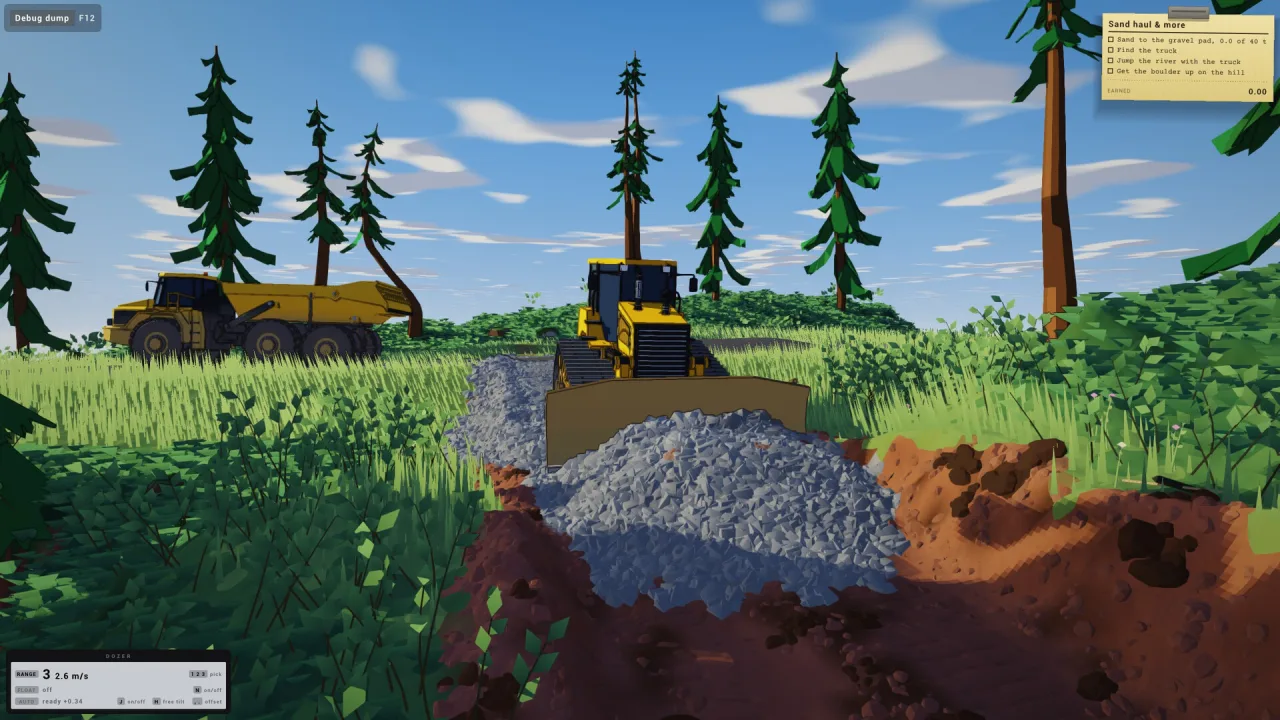
The official road-building toolkit
Road building is not a separate flat-track editor. It is work performed inside the same persistent terrain simulation:
| Action | What the official description establishes |
|---|---|
| Fell or crush trees and brush | Clear a route through wilderness |
| Move or hook rocks | Remove obstacles; rocks can be drilled into for hooking |
| Dig ditches | Part of the listed road-creation actions |
| Haul and crush gravel | Build and improve the road surface |
| Set sticks + Dozer auto level | Shape slopes and curves |
| Buy a compactor | Side-mission option for easier transport |
| Drain a swamp | Side activity that can expose more resources |
The exact buttons, stick-placement interface and machine setup are not in the official public text. For that reason, this is a systems guide rather than a fabricated key-by-key tutorial.
A source-grounded workflow
- Read the terrain before moving material. Find the wilderness route and the destination you need to reach. Water, trees, rocks and existing slopes are part of the work, not decorative objects.
- Clear and open the route. Use the listed tree, brush and rock interactions to make space for the machine that must pass.
- Move and layer material deliberately. Dirt can be plowed, dug and stacked anywhere. Sand and clay behave differently, so a road is not just a visual line painted on the ground.
- Shape slopes and curves. The Dozer’s stick-based auto-leveling feature is the official tool for this part. We will add exact controls once a released UI or developer tutorial verifies them.
- Improve the driving surface. Gravel hauling and crushing, plus the compactor mentioned in a side mission, are the confirmed road-improvement mechanics.
- Test the real load. The demo’s second objective is to haul sand and see whether the road can handle it. That is the clearest official statement that making a route and proving its durability are separate steps.
Water is part of the road problem
Moisture affects grip and dirt movement. Flowing water and rain-created creeks or puddles mean the route interacts with the simulation after you shape it. Ditches and swamp drainage are therefore more than cosmetic construction options.
There is no published formula for the “perfect” road material, grade or width. Avoid turning a single video route into a universal rule. See terrain physics for the underlying material, moisture and persistence model.
Demo versus Early Access
The free demo gives the compact assignment “Build a road to find sand”, followed by a loaded-road test. Early Access instead begins with a medium-sized map focused on mining and resource extraction, where you break a road for the Hauler and ship material out.
The same core skills carry across, but specific demo objectives and vehicles should not be treated as the full Early Access progression. See vehicles for the machine availability table.